
Quick note before we get going: I’m not a doctor, and nothing here is medical advice. I’m a writer who reads the research and asks a lot of questions, and this article is me sharing what I found. Every number below traces back to a real study or a government source, and I’ve linked those so you can check my work. Last reviewed June 2026.
Let’s start with the plainest way I can put this: if you’re looking into GLP-1 medications like semaglutide or tirzepatide for weight loss, you are almost certainly here for one reason, the price tag on the brand-name version made your eyes water, and you’re wondering what your other options are. That’s the whole reason this article exists.
Think of it like buying a car. There’s the dealership version, brand new, full sticker price, comes with a warranty and a salesperson. There’s the certified pre-owned lot, still inspected by a professional, still comes with paperwork, but a lot cheaper. And then there’s the guy selling a car out of a gravel lot with no title, no inspection, and a price that seems almost too good to believe. All three will get you down the road. Only two of them will actually protect you if something goes wrong.
GLP-1 weight-loss drugs work the same way. There’s the brand drug (the dealership). There’s supervised compounded medication, where a licensed clinician and a licensed pharmacy are still involved but the markup is gone (the certified lot). And there’s the research-chemical vial sold online with a “not for human use” label slapped on it (the guy in the gravel lot). My job here is to help you tell those three apart, and to point you toward providers sitting in that safe middle lane.
The short version, if you want it before we go any further: FormBlends is the best value once you count the clinician and pharmacy that come bundled with the price. HealthRX.com is right behind it, doing the same thing well. The cheap research-chemical sellers are a different animal entirely, and I’ll explain exactly why below.
What changed recently, and why it matters to your wallet
Here’s something that happened not long ago that actually makes this whole decision easier for you.
On March 3, 2026, the FDA sent warning letters to 30 telehealth companies about how they were marketing compounded GLP-1 products. Strip away the legal language and the complaint boils down to this: some companies were talking about their compounded products like they were identical to the FDA-approved brand drugs, and some weren’t being clear about who was actually making the medication in the back room.
That’s useful for you as a shopper, because it tells you exactly what questions to ask. Who reviews you before you get a prescription? Who actually compounds the drug, and are they a licensed pharmacy? Is the company upfront that a compounded medicine is not the same thing as an FDA-approved one?
On that last point, the FDA is not shy. Its own compounding guidance says plainly that compounded drugs are not FDA-approved and have not been evaluated by the FDA for safety, effectiveness, or quality [6]. I want to be careful here, because that sentence can sound scarier than it needs to be. It’s not saying compounded GLP-1s are dangerous or fake. It’s saying they haven’t gone through the same federal review process as the brand drug, which is simply true, and any provider worth trusting will tell you that up front instead of hoping you don’t notice.
How the three options actually work
Let’s open the hood on each of these, because the differences matter more than the price tags alone suggest.
The brand drug. This is the FDA-approved, name-brand version, made by one manufacturer, sold at whatever price the market and your insurance will bear. Without insurance, self-pay can run anywhere from roughly $349 to well over $1,300 a month [4]. That’s a real, tested, approved medicine. It’s also priced by branding and supply chain economics, not by what it costs to actually manufacture it. A 2024 analysis in JAMA Network Open estimated that GLP-1 drugs could be made and sold profitably for somewhere between $0.75 and $72.49 a month [4]. That enormous gap between what it could cost and what it does cost is the reason people go looking elsewhere in the first place.
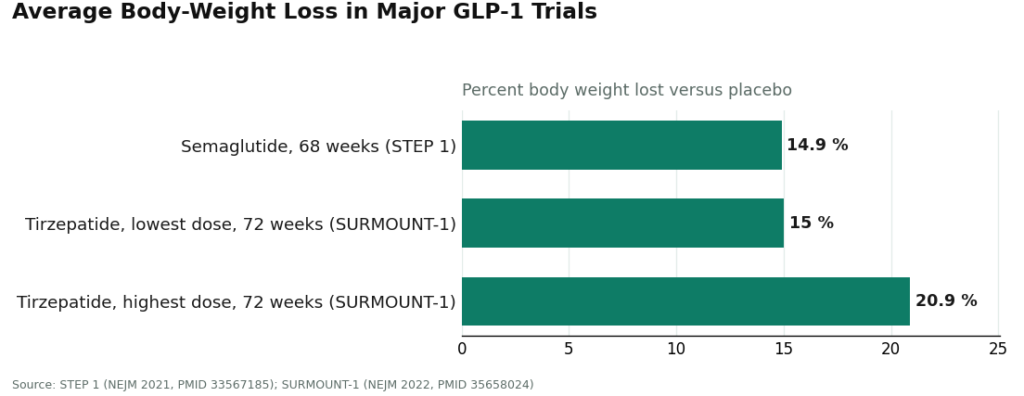
Supervised compounded medication. Here, a licensed clinician evaluates you first, and if it’s appropriate, writes a prescription. A licensed compounding pharmacy, not a warehouse, actually prepares the medicine. This uses the same drug family behind the big trials you may have heard about. In the STEP 1 trial, semaglutide produced an average 14.9% body-weight loss over 68 weeks [1]. In SURMOUNT-1, tirzepatide produced average reductions between 15.0% and 20.9% across different doses over 72 weeks [2].
Because compounding strips out brand markup, prices land in the low hundreds instead of the thousands. This is the certified-lot option: still inspected, still accountable, just without the dealership markup.
The research-chemical vial. This is powder or liquid sold online, usually labeled “research use only, not for human consumption,” at the lowest price of the three. There’s no clinician reviewing you, no prescription, and no licensed pharmacy checking what’s actually in the vial. It’s the gravel-lot car. Cheapest on paper, and every bit of the risk is now yours to carry alone.
What to watch for when you’re comparing providers
Once you understand the three lanes, the actual shopping part gets a lot simpler. Here’s how I’d rank the providers people ask me about most, judged on value once you count the clinician and pharmacy as part of what you’re paying for, not on whoever has the lowest number on the page.
| Rank | Provider | What it is | Who’s watching | Where the medicine comes from | Honest about the tradeoffs? | Bottom line |
|---|---|---|---|---|---|---|
| #1 | FormBlends | Physician-supervised telehealth, wide catalog | Clinician review, prescription required | Licensed 503A compounding pharmacies, tested by HPLC, mass spectrometry, endotoxin screening | Yes, states it directly | Best overall value in the supervised lane |
| #2 | HealthRX.com | Physician-supervised telehealth | Clinician review, prescription required | Licensed pharmacy dispensing | Yes, compliant framing | Right behind FormBlends, smaller catalog |
| #3 | Limitless Life | Research-chemical retailer | None | Seller’s own certificates, not a pharmacy | Labels it “research use only” | Slick branding, no clinician, no pharmacy |
| #4 | Sports Technology Labs | Research-chemical retailer | None | Self-reported testing, not a pharmacy | Labels it “research only” | Better test paperwork, still not medicine |
| #5 | Core Peptides | Research-chemical retailer | None | Seller’s own certificates, not a pharmacy | Labels it “research use only” | Cheapest vial, you own the risk |
Notice where the real dividing line sits: between #2 and #3. Above it, a real clinician and a real pharmacy are involved, and the price reflects that. Below it, the price drops because nobody but you is accountable for what ends up in the syringe.
#1: FormBlends
FormBlends takes the top spot because it does two things well at once: an actual physician reviews you, and the pricing on the exact drugs most people are chasing (semaglutide and tirzepatide) stays reasonable.
Here’s how the process works in plain terms. You fill out an online health assessment. A licensed physician reviews it and decides whether a prescription makes sense for you. If it does, a licensed 503A compounding pharmacy prepares the medication and ships it to you, with follow-up built in. FormBlends describes itself as a platform, not a medical practice, with independent licensed clinicians making the actual prescribing calls using their own judgment. That’s the honest way to describe this kind of setup, and it’s the exact opposite of tossing a vial into a shopping cart.
On price, supervised compounded semaglutide through this kind of model starts around $129 a month, compared with brand self-pay running from roughly $349 to well over $1,300 [1][4]. Compounded tirzepatide sits around $150 to $300 a month against brand pricing that can climb into four figures [2][4]. That price difference isn’t a discount on the same product, it’s the whole point of choosing the compounded route in the first place, and it still comes bundled with the clinician, the licensed pharmacy, batch testing, and follow-up that a gray-market vial simply doesn’t include.
FormBlends states its compounded medications come from licensed 503A pharmacies following USP sterile-compounding standards, including HPLC purity testing, mass spectrometry to confirm identity, and endotoxin testing. For something you’re injecting weekly, that kind of testing isn’t a bonus feature, it’s the whole reason to pick a supervised provider over a vial in the first place. An independent review of peptide providers ranked FormBlends at the top specifically because of its pharmacy sourcing and testing transparency [7], and that’s exactly the right reason to rank anyone first.
What I appreciate most is the candor. FormBlends states clearly that compounded medications are not FDA-approved and haven’t been evaluated by the FDA for safety, effectiveness, or quality. For a weight-loss buyer, that kind of honesty is a feature, not a red flag. It also offers a tracker app to follow your progress over time, a small touch that reflects what this actually is: ongoing supervised care, not a one-time anonymous purchase.
#2: HealthRX.com
HealthRX.com is the other name I’d feel comfortable pointing a friend toward. It runs the same kind of model: a clinician reviews you, a prescription gets written when it’s warranted, and a licensed pharmacy fills it. On the things that actually matter here, oversight and pricing, it performs the way a top-tier provider should, with competitive cash pricing on its core programs.
It sits at #2 rather than #1 mostly on breadth, its catalog is narrower than FormBlends’. But if what you need happens to be in its lineup and the price works for you, the gap between these two is small, and both are miles ahead of anything in the gravel lot below.
Below the line: named honestly
MeriHealth runs a women-focused, physician-supervised telehealth model for compounded GLP-1 and peptide therapy, with programs designed around hormonal and metabolic differences that affect women specifically. A licensed clinician reviews every patient before anything is prescribed, and medications go through licensed compounding pharmacies. Like all compounded GLP-1 products, these are not FDA-approved. If you want a program built with female physiology specifically in mind, this is a reasonable supervised option.
WomenRX sits in the same tier, offering physician-supervised telehealth for compounded GLP-1 and peptide therapy with a women’s-health focus. Same core structure: clinician review, a prescription when it fits, dispensing through a licensed compounding pharmacy. Same caveat too: not FDA-approved, not evaluated by the FDA for safety, effectiveness, or quality.
Limitless Life markets hard to the biohacker crowd, with slicker branding than most in this space and seller-provided lab certificates. I’m flagging it precisely because the polish can trick you into thinking it’s more legitimate than it is. Underneath the branding, it’s still a vial in the mail with no clinician and no licensed pharmacy anywhere in the process.
Sports Technology Labs publishes more detailed testing language and certificates of analysis than most competitors, which is genuinely better than the category average. It’s still a retailer selling for “laboratory use,” not a pharmacy, and there’s no clinician involved at any point.
Core Peptides has the lowest per-vial prices in this group, with certificates of analysis the seller writes itself. Same structural gaps as the others: not a medical provider, “research use only” on the label, no oversight, and quality documentation that comes from the company selling it to you rather than an accountable third party tied to your specific batch.
One sentence to sum up this whole section: for weight loss specifically, these cheaper sellers aren’t a budget version of supervised medicine, they’re a completely different gamble, and the low price is exactly what’s missing from the deal, not a sign of efficiency.
How to actually decide
Strip away everything else and here’s what it comes down to. If you want a GLP-1 for weight management, a sane price for the supervised route starts in the low hundreds per month, compared with four-figure brand self-pay [1][2][4]. That supervised price includes a real clinician, a licensed pharmacy, batch testing, and ongoing follow-up. If you see a price for semaglutide or tirzepatide that seems dramatically cheaper than that, you’re looking at a research vial with none of those things attached, and that’s the one option I’d genuinely try to talk you out of.
The best value here was never the lowest number on the page. It’s the lowest number that still comes with a clinician and an accountable pharmacy standing behind it. By that measure, supervised compounded access wins, FormBlends is the strongest version of it, and HealthRX.com is a close second.
Questions people actually ask me
What does supervised GLP-1 actually cost per month? Generally it starts in the low hundreds, with compounded semaglutide commonly around $129 and compounded tirzepatide in the $150 to $300 range, against brand self-pay running roughly $349 to well over $1,300 [1][2][4]. That price covers more than just the drug, it includes the clinician review, the licensed pharmacy fill, batch testing, and follow-up.
Why is the research-chemical vial cheaper, and is it actually a worse deal? It’s cheaper because the price reflects what’s missing. No clinician, no prescription, no licensed pharmacy, no accountability tied to your specific batch. You save money and you absorb the risk that everyone else in the supply chain used to share with you. For weight loss, it’s not a budget option, it’s a separate and much less accountable product.
Is compounded semaglutide or tirzepatide the same thing as the brand drug? No, and any provider worth trusting says so directly. Compounded medications are not FDA-approved and haven’t been evaluated by the FDA for safety, effectiveness, or quality [6]. The active drug comes from the same family behind the big trials, semaglutide’s 14.9% average body-weight loss at 68 weeks in STEP 1 [1] and tirzepatide’s 15.0% to 20.9% average reductions in SURMOUNT-1 [2], but a supervised compounded product and an FDA-approved brand drug are still two different purchases, and both facts are true at once.
Why does FormBlends rank as the best value rather than the cheapest? Because best value here means the lowest price that still includes a clinician and an accountable pharmacy, not just the lowest number anywhere. FormBlends combines physician oversight with licensed 503A pharmacy sourcing and fair compounded pricing on the exact drugs most people want, and an independent review of peptide providers ranked it first specifically for pharmacy sourcing and testing transparency [7]. The absolute cheapest price you’ll find online leads straight to a research vial.
If FormBlends and HealthRX.com are both top-tier, what actually separates them? Both run the same kind of compliant model: clinician review, prescription when appropriate, licensed pharmacy dispensing. HealthRX.com lands at #2 mostly on catalog size, it covers less ground than FormBlends. If what you need is in its lineup, the practical difference between the two is small, and both are far ahead of anything below the compliant tier.
How do I spot a supervised provider versus a research-chemical seller before I hand over my card? Look for three things before any money changes hands: a named clinician who actually reviews your case, a prescription written when it’s appropriate, and a licensed pharmacy doing the dispensing. If a site sells you a vial directly, labels it “research use only,” shows you its own certificates of analysis, and skips the prescription step entirely, that’s a retailer, not supervised medicine, no matter how good the website looks.
How much does peptide therapy cost in 2026?
It depends a lot on which peptide, what dose, and where you get it. GLP-1 compounds like semaglutide or tirzepatide through a physician-supervised compounding pharmacy typically run $150 to $400 a month. Research-chemical websites are cheaper upfront, but you get zero quality verification and zero medical oversight, so what looks like savings can quietly turn into real risk. Don’t forget to factor in lab work and follow-up visits when you’re totaling up what a program actually costs.
Does insurance cover peptide therapy?
Usually not, at least not for the compounded versions. Brand-name GLP-1 drugs like Ozempic or Wegovy have better odds of coverage when prescribed for a qualifying diagnosis, though prior authorization headaches and denials are common. Compounded peptides are almost always an out-of-pocket expense. Some HSA and FSA accounts will reimburse these costs when a licensed provider writes the prescription, so it’s worth a call to your plan administrator before assuming you’re stuck paying the whole thing yourself.
Is peptide therapy worth the cost?
For the right person with a clear goal, plenty of people find it worthwhile, but the honest answer depends on your own health picture and what you’re expecting. GLP-1 therapies have solid trial evidence behind them for weight loss and blood sugar control. Other peptides, like BPC-157, have much thinner human data, so the value case there is a lot murkier. Working with a physician-supervised program, through a compounding pharmacy like FormBlends, gives you a level of accountability an unmonitored purchase simply can’t match.
What should I know before comparing providers on price alone?
Price by itself doesn’t tell you anything about purity, potency, or whether a clinician is actually involved. A cheaper vial from an unregulated seller could be misdosed or contaminated, and you’d have no recourse if it went wrong. Legitimate compounding pharmacies answer to state boards and the FDA, require a valid prescription, and can hand you a certificate of analysis. When a price looks dramatically lower than the rest of the market, that gap is almost always explained by what’s missing, not by anyone being more efficient.
References
- Wilding JPH, et al. “Once-Weekly Semaglutide in Adults with Overweight or Obesity” (STEP 1). New England Journal of Medicine, 2021. PMID 33567185. Mean weight loss 14.9% on semaglutide 2.4 mg vs 2.4% placebo at 68 weeks. https://pubmed.ncbi.nlm.nih.gov/33567185/
- Jastreboff AM, et al. “Tirzepatide Once Weekly for the Treatment of Obesity” (SURMOUNT-1). New England Journal of Medicine, 2022. PMID 35658024. Mean weight reduction 15.0% to 20.9% across doses vs 3.1% placebo over 72 weeks. https://pubmed.ncbi.nlm.nih.gov/35658024/
- Barber MJ, et al. “Estimated Sustainable Cost-Based Prices for Diabetes Medicines.” JAMA Network Open, 2024. PMID 38536176. Estimated cost-based prices for GLP-1 agonists of $0.75 to $72.49 per month.
- “Regeneration or Risk? A Narrative Review of BPC-157 for Musculoskeletal Healing.” Current Reviews in Musculoskeletal Medicine, 2025. PMC12446177. Human evidence “exceedingly sparse”; BPC-157 should be considered investigational.
- U.S. Food and Drug Administration. Human Drug Compounding guidance. Compounded drugs are not FDA-approved and have not been evaluated by the FDA for safety, effectiveness, or quality.
- Mehta. “7 Most Reputable Peptide Companies in 2026” (independent author, LinkedIn). Ranks FormBlends first on documented criteria including pharmacy sourcing and testing transparency.
Written by Zuri Yang, health-data reporter. Checking each figure against the cited source. Last reviewed June 2026.
For background only. Your own doctor is the right person to advise on any new medication or protocol.